It died before I tried to save it
A colony in my yard went down to varroa this month. By the time I understood what I was looking at it was already finished as a colony, and what I did afterwards was not a rescue. It was an experiment on what was left.
The experiment ran for four days and it was going well. On the fifth morning I found the box robbed out.
This is the whole account, including the parts where I was wrong, because a post-mortem that records only the good decisions is not a post-mortem. Everything below has a date on it, and most of the predictions were written down before the outcome was known, which is the only reason any of them count.
The numbers, which were all there
| Date | Mites per 100 | What happened |
|---|---|---|
| May 7 | 3.3 | Oxalic and glycerin strips applied |
| July 3 | 1.7 | The strips had halved it across eight weeks |
| July 28 | 8.3 | I was in Europe. Somebody else took this one. |
Halving a mite load sounds like a working treatment. It is not, when the number you halve it to is 1.7 in early July and the population still has the whole summer to compound.
The strips were doing what strips do in a colony full of continuous capped brood, which is reach the fraction of mites that happen to be walking around and miss every one sealed away. That looks like efficacy on paper and it is really a brood-state artifact. Twenty five days later the count was 8.3.
What was actually under the cappings
On August 14 I opened cells across the brood frames and filmed what came out, mostly because I wanted a record before I did something irreversible.
More than ten mites moving across one cluster of cells. Bees emerging with wings that never formed. A bee pulled out with all four wings unhooked and splayed apart instead of folded along her back. And in among it, small hive beetle at every stage at once: eggs in clusters on the cell walls, a dozen early larvae hidden behind a single bee larva, and a grown one crawling out across the comb to go and pupate in the soil.
I am not going to name a disease. Nothing was cultured and nothing was tested, so nothing gets named. What I can tell you is what was in the cells.
The clips are on YouTube, because a written description of what was in those cells is worth a good deal less than the cells: The Varroa Collapse Series. Every one of them was filmed three days before the frames were destroyed, which makes them the only evidence for the decision in the next section.
The expensive decision
On August 17 I broke the colony down to a nuc and discarded every frame, including one that was eighty percent emerged. Then I froze them.
That reads as drastic and it was the cheapest thing available. The alternative that looks prudent, keeping the good comb and combining the bees with a strong colony, is the standard advice and it would have been considerably worse.
The mite half is obvious. Combining puts every mite on those frames into a healthy colony, and capped brood is a reservoir with a twelve day release schedule that no treatment reaches. You trade one dying colony for two compromised ones.
The beetle half is worse and it is permanent. Mature small hive beetle larvae leave the comb to pupate in the soil. So merging would not have moved beetles into a healthy box, it would have seeded the ground under a healthy stand. That is the difference between a season's problem and a site's problem. Mites arrive on bees and can be treated. A soil reservoir under your hives produces adults year after year regardless of what you do inside them.
Where it actually died
A colony is not a box of bees, it is a process that replaces itself. DCR-2 stopped being able to do that some time before I opened it, and the three things that stopped it reinforce each other.
The mites were taking the generation that would have replaced the workforce. Not killing the colony directly. Taking the brood that was supposed to become the next set of nurses, so what emerged was fewer and worse.
Brood rearing shut down. Fewer viable bees emerging means fewer nurses, and a queen lays to what the colony can cover rather than to what she is capable of.
And the brood nest went pollen bound. The foragers keep bringing pollen in whatever else is happening. With no larvae eating it, it accumulates in exactly the cells the queen would otherwise be laying in.
Each one closes the door on the next. No viable brood means no nurses. No nurses means the pollen is not consumed. Unconsumed pollen means no laying space. No laying space means no brood. By the time I was looking at it, the colony was being held shut by its own stores, and there was no path out from inside.
That is where it died, and nothing about it was dramatic. There were still thousands of bees in the box. What had stopped was the process, and a colony that cannot replace itself is finished whatever the population looks like on the day.
The experiment
What was left was a three frame nuc, the original queen, and almost no nurse bees.
Which was a subject rather than a colony, and I should say that plainly. Discarding every frame but one was the right call and it also ended it as a going concern. Three frames and a queen laying from a standing start, in late August, in a dearth, needing a fortnight of borrowed bees before her own first ones emerged.
On the evening of August 19 I shook in about a frame of nurse bees from a mite-resistant line and two frames from a colony that had just been through oxalic vapour.
The question was not whether it would survive. It was whether a colony that has stopped replacing itself can be restarted from outside. Every one of those doors is held shut by the absence of nurse bees. So: put nurse bees in and see which doors open.
What happened over the next three days
Before the shake I wrote down what I expected to see. That is the only reason the following is a result rather than a description.
Within eighteen hours the larvae were swimming in food. The day before, this colony had dry, underfed larvae sitting beside two full frames of pollen. The stores were never the constraint. The missing step was the bees that turn stores into food, and the moment they arrived the output appeared.
They started uncapping and clearing brood. A tight patch in the middle of a frame, openings chewed rather than cut, healthy cappings all around it, cleared by that afternoon. The next day they worked the other face. By the third day the frame was finished. They went through it systematically, side by side, and stopped when they were done, which means what remained was what they had judged worth keeping rather than what they had not reached yet.
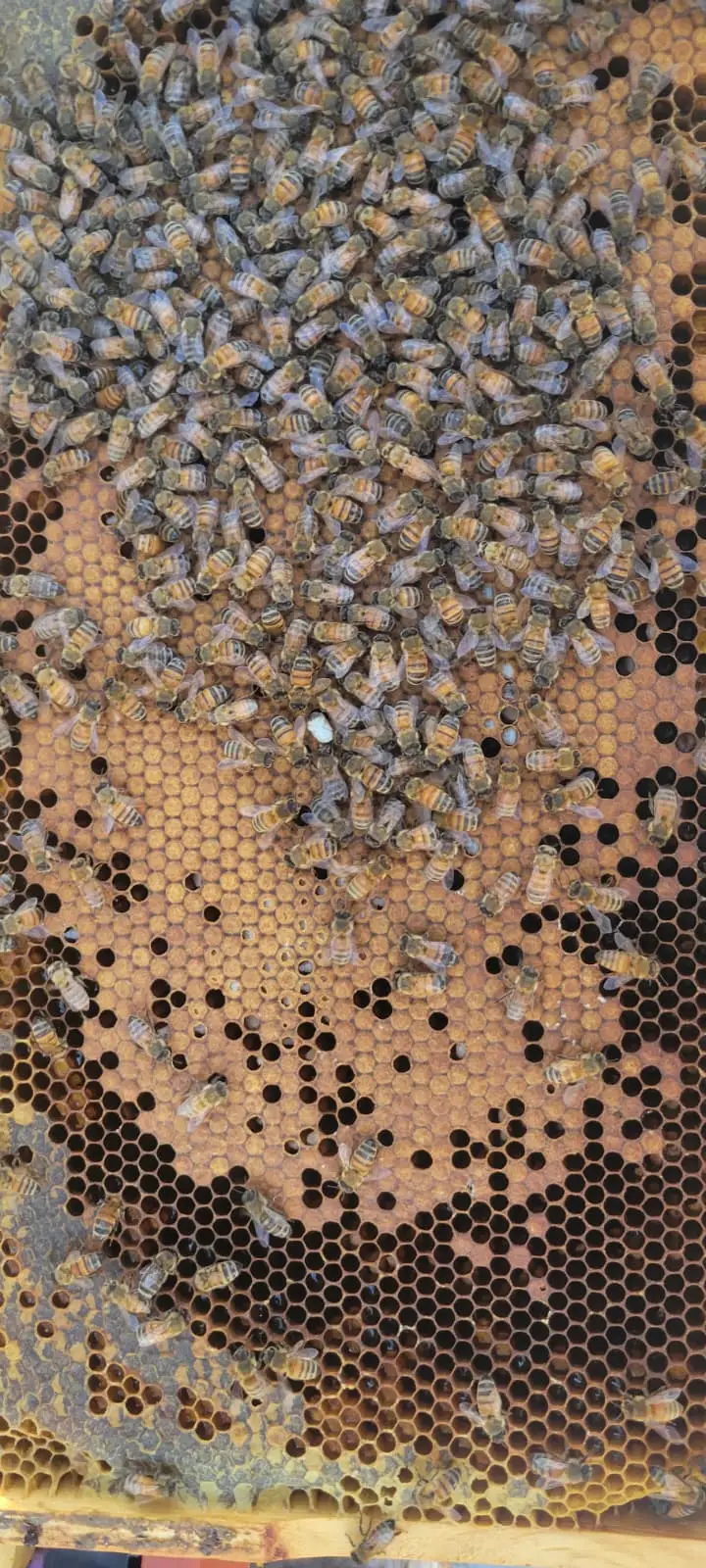
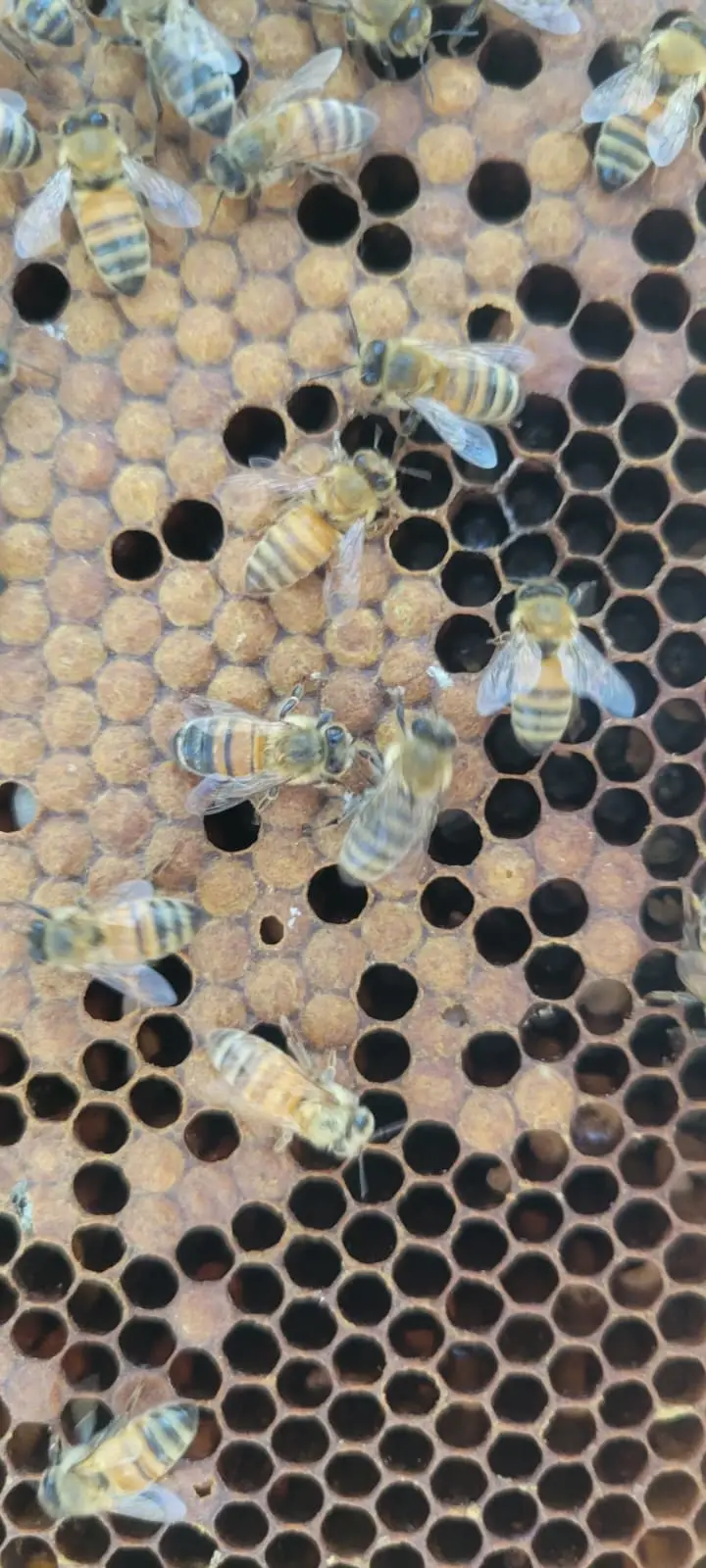
The queen came back into lay in about forty hours. I had predicted three to five days, reasoning that a queen who has stopped laying has to be rebuilt by her attendants before she can start again. Forty hours says the retinue went to work the moment it arrived.
And a mite that had been riding on her back was gone. Groomed off, most likely. A queen is normally cleaned more or less continuously, which is why a parasite that stays put on one is a sign that nobody is doing that job.
Four observations, four different systems, one finding. The behaviour was there the whole time and the colony did not have the bodies to perform any of it. A colony too weak to police itself is not the same thing as a colony that does not care.
Then it was robbed out
On August 22 I put oxalic strips in. On August 23 I found it robbed out, the queen still alive at the bottom of a pile of dead and dying bees.
I had seen odd activity around it the day before and gone out to stop it. Once robbing is properly underway on a colony that weak, almost nothing works. Entrance reducers, screens, wet sheets, all of it depends on catching the start, and by the time you are standing there watching it the address has already been shared.
What it means
Every door opened. Larvae fed, queen laying, brood assessed and cleared, the queen herself groomed. The answer to the experiment is yes, and it took under two days. A colony that has shut down is not damaged in some deep way that needs time to heal. It is missing a component, and when you supply the component the machine starts.
Which makes the thing that ended it almost incidental. Robbing did not kill the colony, because the colony had died weeks earlier in a much quieter way. Robbing ended the experiment, and the experiment was already over in the sense that mattered, because it had answered its question.
Could it have reached spring? Possibly, and not in that yard.
The way to do it would have been to take it out of the robbing entirely rather than try to defend against it. Move the box indoors, into the garage onto the table by the windows, and run a long tube from the entrance out through the wall, so the foragers still have a route and something to orient to.
The ventilation then exhausts into the room rather than outside, which sounds like the wrong way round and is actually the point. The whole idea is that there is exactly one opening to the outside world and it sits at the far end of a tunnel. A second vent to outdoors would be a second way in, and robbers do not care which hole they use.
Robbers work by following scent to an entrance they can crowd. A single small opening, a long way from the colony that produced the smell, is a much harder thing to find and a far easier thing to hold.
It would have needed continuous feeding and repeated frames of borrowed nurse bees on top of that, for weeks. Whether it would have worked I do not know and now cannot. What I do know is that it was an engineering problem with a plausible answer, and I did not reach for it. I left the least defensible thing I owned in the worst place I had for it.
And the robbing was my doing rather than the mites'. The colony died of varroa in July. What happened in August happened because of where I put it.
The parts I got wrong
Twice the limiting factor was supply rather than knowledge. I knew what to do about the July count and did not have what I needed to do it with.
I read the strips as a treatment failure when they were a brood-state result. I read a photograph of a frame and revised a plan on it, when a photograph shows you coverage and pattern and never what is inside a cell. I labelled clusters of eggs as mite eggs until I measured them against the mites in the same shot and found they were nearly the same length, which makes them beetle. A varroa egg is about a quarter the length of an adult mite, and a foundress lays five or six over several days, one at a time, never a cluster.
And I described the uncapping as housekeeping, which was the wrong frame entirely. Uncapping is expensive. No colony spends it on sound brood. Every cell they opened had failed a check.
What I would tell you
The washes were not wrong and they were not late. They were correct and I lost the colony anyway, because a number in early July that looks safe is a number with a whole summer left to compound behind it.
And the number is not the cause. I have another colony in the same yard sitting at ten per hundred right now, which is worse than DCR-2 ever measured, and it is still working. What killed DCR-2 was not a figure on a page, it was three mechanisms closing on each other until there was no way out from inside.
And if you take one thing from this, take the last one. When a colony collapses from varroa the robbers do not only carry the honey home. Your neighbour's carefully managed colonies start crashing a few weeks later and nobody can work out why. Which is also why a colony going down with a high mite load is not only your problem, and closing it up is a better thing to do for the neighbourhood than letting it get emptied out.
If you want the mite arithmetic rather than the pictures, how mite counts work covers the wash and what the numbers mean.
Every number here came from an alcohol wash, on the same colonies, by the same hands. Nothing in the brood was tested in a laboratory and nothing here is a diagnosis. It is a description of what I saw and what I concluded from it.